Friday, 13 April 2018

Growing Egg Plant (Brinjal)


The brinjal (Solanum melongena) is a warm-season crop grown for its edible fruit.

Climate is one of the most important factors that determine planting times, and the wide climate variation in SA means that good-quality brinjals can be grown in open lands across various parts of the country year-round. The brinjal cannot tolerate very low temperatures; the minimum it can withstand is around 10°C, and the maximum is 34°C.  The optimum temperature for brinjal cultivation is between 26°C and 29°C.  The earliest seedling establishment period is when soil and air temperatures meet the minimum requirements for plant growth. The latest seedling establishment period should allow for growth and harvesting to be completed before adverse conditions set in.


Preferred soil types
Brinjals favor a well-drained loam to sandy loam soil, but will grow reasonably well in a wide range of different soil types.  However,  certain criteria in terms of the soil structure and content must be met to make the crop commercially viable.  These include nutrient composition, compaction, effective soil depth, pH, crop rotation, herbicide residue and the water-holding capacity of the soil.

Varieties
Different varieties produce fruit of different sizes, shapes and colors, varying from white to yellow or green, reddish-purple and dark purple.

The currently favored cultivars produce a fruit that is egg-shaped, 12 cm to 25 cm long and 6 cm to 9 cm in diameter, and has a dark purple skin.

How to prepare the soil
Good soil preparation will improve the potential for profitable brinjal production. Primary soil preparation must create growing conditions that enable the plants to develop the optimal root system.  Most roots occur in the top 600 mm of the soil.  Soil preparation depends on the soil type and the specific variety’s requirements.  On sandy soils, the focus should be to reduce compaction and erosion; on heavier soils, the aim is to reduce crust formation.  Soil should be worked to a depth of between 200 mm and 400 mm.

Ridging is highly recommended, but this should be done according to the land contours. This keeps excess water away from the plant, improves root zone aeration, increases soil depth in the growing bed and promotes root development.

Growing seedlings

Brinjals reproduce by seed. Seedlings should first be established in 128- or 200-hole trays and then transplanted. Although more expensive, the larger 200-hole trays ensure better root development.  Deep sowing is better in warmer conditions, as seedlings take longer to emerge at longer growing distances and cooler temperatures.  Shallow sowing is better under cooler conditions, as seedlings emerge sooner due to shorter growing distances and higher temperatures.  If possible, place seed at a uniform depth using a precision seeder. Grow the seedlings in a well-aerated medium, with good water-holding capacity and a pH of around 6,5. Peat, bark and vermiculite mixes provide good results.

Potential problems
Typical difficulties at this stage include an excessive tannin level and low soil porosity, resulting in poor drainage and green mould build-up. Pre-enrich the medium and fertilise the seedlings 10 days after germination, using a liquid fertiliser.  Keep the seedlings moist, but not wet, by using a watering can or hose with fine spray.

In hot season, seedlings take four to six weeks to reach transplant maturity. In cold, they take approximately eight weeks.
\
#Happyfarming


Tuesday, 10 April 2018

Growing Pumpkins

In some countries, bush-type varieties are available.The leaf area of these is not large enough to produce more than one or two fruits; for a better yield, the plants must be spaced very close together.

Ultimately, however, the type is less important than the size of fruit and the yield, or the number of fruit per hectare.

Seed is expensive, so space the plants further apart if you can still obtain a good yield.

The old Boer pumpkin is a strong runner that starts producing fruiting flowers only when the runners are quite long. The maximum yield is only about 25 t/ha, however, whereas modern grey-skinned varieties have a substantially higher yield potential.

Spacing is all important, because when the pumpkins ‘join up’ between the rows, they start aborting fruit, a remnant of a primitive survival trait.

The plant’s main objective is to produce seed for the next generation; your eating pleasure is of little consequence. The plant, therefore, tends to strike a balance between the amount of fruit it sets and the leaf area it requires to support the fruit to seed maturity.

Different varieties abort fruit at different times, but all obey the same principle: the plant will not set more fruit than can reach maturity. Moreover, it is often conservative in this regard, so spacing really is important.

Cool weather
Other factors also play a role. A lower average temperature results in the distance between the inter nodes of the vines being shortened and causes the first female fruit to be set closer to the crown.

This means that more fruit will be set on the vines before the rows meet in the middle. Row spacing can therefore vary within one variety depending on the time of the year being planted.

Shorter day-length, often coupled with cooler weather, will also cause fruit to be set closer to the crown.

Finally, conditions in the land can influence spacing in an unexpected way. Good management and high fertility will produce more vigorous vine growth, causing the vines to meet in the middle and start aborting fruit.

For this reason, ironically, yield may be higher where there has been neglect or poorer fertility!

For a good yield
This doesn’t mean that you should not strive for ideal conditions. It just means that when growing conditions are good, you should space the rows further apart. Put another way, for a good yield, the fruit population should be set before the entire area is covered.

#HappyFarming2018

Thursday, 22 March 2018

To mark World Water Day 2018, here are some mind-blowing and alarming facts.

“Water scarcity, poor water quality and inadequate sanitation negatively impact food security, livelihood choices and educational opportunities for poor families across the world. Drought afflicts some of the world’s poorest countries, worsening hunger and malnutrition.”

According to the U.N., 2.1 billion people don’t have safe drinking water at home.
Of those, 844 million don’t have access to a basic drinking water service, including 263 million people who travel for over 30 minutes per trip to collect water.
And 159 million still drink untreated water—a serious health risk—from surface water sources, such as streams or lakes.

There are 663 million people who live without a safe water supply close to home.


About 71% of the Earth's surface is water-covered, according to The United States Geological Survey Water Science School.
The world’s total water supply equates to 332.5 million cubic miles.
Oceans hold around 97% of all Earth's water, which means all but about 3% of our water is saline.
Of the world’s total freshwater, 69% is frozen in ice and glaciers and another 30% is in the ground.
Just 0.26% of the world’s water is in freshwater lakes.
And only 0.001% of all our water is in the atmosphere.
By 2050, the world’s population will have grown by an estimated 2 billion people—nearing 10 billion—increasing demand for water by up to 30%, predicts the U.N.
Over 80% of society’s dirty wastewater flows back into the environment without treatment or reuse.
As much as 71% of the world’s natural wetlands have been lost since 1900—and it’s humans’ fault.

Also check World Water Day 2018: 80 Powerful Images to Make You Think Twice about Leaving Your Shower Running

Source http://www.newsweek.com/

Friday, 2 March 2018

FERTILIZING CROPS CORRECTLY


Farmers frequently ask us for specific fertilizer for their crops. Dripsol company fraternity would happily oblige if all crops were the same!


How to fertilize a crop correctly


 This can only be done if the organic status and soil life are healthy enough to ensure that recycling of nutrients takes place. Unfortunately, each crop is different because each land is unique. Each land has its own reserve of nutrients and this must be taken into account when determining a crop’s fertilizer requirement. This is why it’s necessary to have the soil analysed. Only once you have these results can you determine how to fertilize according to the specific needs of the crop.

The nutrients in the soil are bound in clay colloids and may not be readily available to the plants due to the soil pH or the action of certain minerals. As a result, the nutrients must first be ‘altered’ chemically or biologically before the plants can use them.

Phosphorous, for example, can be in the form of Iron Phosphate, Aluminium Phosphate or Manganese Phosphate. In any of these states, it is unavailable to plants. Fertilizer companies therefore finely grind rock phosphate and treat it chemically. Applied to a crop, this makes phosphate available to plants. The duration of this availability will depend largely on the soil’s pH. Plants convert the sun’s energy into sugary substances in their leaves and exude these from their roots to supply soil microbes. About 30% of the energy used by the plants goes into feeding microbes, and these in turn make nutrients available to the plant. If we don’t consider the value of a healthy microbial environment in the soil, the plants certainly do!

Organic content also acts as a buffer. A hectare of good soil with a healthy organic content can contain up to 5t of soil organisms. These represent a reservoir of nutrients that are constantly recycled and provide food for plants. A healthy, balanced quantity of minerals in the soil is good for all crops, especially vegetables. Once you have achieved this, you need only ‘top-up’ where necessary, irrespective of the crop.

More soil organisms present in the soil, fewer worries 

The higher the organic content of the soil and the accompanying soil life, the less you need to know about soil fertility and the less important mineral imbalances become. Farmers and fertilizer companies place too much emphasis on establishing the precise quantity of fertilizer to apply to each crop instead of getting the soil properly fertile in the first place. How soon you can achieve this depends on your operation. Field crops do not always have enough of a profit margin for a farmer to fast-track the process but the principles remain the same.


Soil health

 Compost  is  a  mixture  of  dead  plants,  roots  and leaves. If your soil is heavy clay adding compost will help the soil drain water . If your sandy, adding compost will help the soil hold more water. Adding compost brings earth worms and other living things that help plants and roots grow strong and healthy. Vegetable farmers,  have too much to lose by ignoring soil fertility. Focus on improving soil health as soon as possible – by increasing organic content, achieving the correct mineral balance and tilling as little as possible.  As world population and food production demands rise, keeping our soils healthy and productive is of more importance.

Happy Farming,

contact us for drip irrigation quotes sales@dripsol.com  +254 (0) 746-300-055 / +254 (0) 7-3869-0937 


Sunday, 18 February 2018


Challenges facing Onion Farming,

Rains or Excess Watering: Too much rains or excess watering can water log the crop. If the rain in your area is too much, focus on growing the crop during the short rains. You can also raise the beds to ensure the water flows out of the field. Avoid excessive watering of your onions. The best type of irrigation on onions is drip irrigation. Overhead irrigation should be avoided as it causes fungal diseases.

Diseases: Common diseases that affect onions include Downy Mildew, Bacterial Soft Rots, Pink/White Root, Botrytis, and Rusts. Use herbicides to get rid of the diseases.

Pests: Common pests that attack onions include maggots, thrips, nematodes and the leaf miner. Use pesticides from accredited brands to get rid of the pests.

Weeds: Weeds can also destroy your crop and should be removed occasionally either physically or through the use of herbicides. In one season, there should be at least 2 – 3 weeding sessions.

Harvesting onions


The best time to do the harvesting is during the dry season. Keep a calendar and record the essential dates to ensure you harvest at the right time. Bulb onions are ready for harvesting once they form a shiny membranous cover around the bulbs or when the foliage withers. Spring onions are ready for harvesting when they are 15 centimeters tall and 1.5 centimeters thick.

Harvesting is done by pulling the bulbs and then chopping off the leaves. You then dry the bulbs in the sun before storing the produce.

Hope that's all you need to know about growing onions, for any question write to us through sales@dripsol.com,

Thursday, 15 February 2018


Growing Onions!


Half percent of the red onions in Kenya are imported from our neighboring country, Tanzania, as indicated by Food and Agriculture Organisation's (FAO) 2014 report. Kenyan Farmers have been doing their best to address the demand and close the gap, but there is still more supply to be achieved. This makes the Red Bulb Onion a very attractive commercial investment for the Kenyan market at the moment, since local production is not enough.

Major types of onions farmed in Kenya are bulb onions and spring onions. Bulb onions take 3 to 4 months to reach maturity. Spring onions are easy to plant. You can even plant them at your kitchen garden. They are commonly used in vegetable salads or as seasoning in soups. Some of the health benefits of spring onions include lower blood sugar and decreasing blood pressure and cholesterol levels.

Of the two types, bulb onions are more popular than the spring ones due to their long shelf life and sweet taste. Currently, there are two different varieties of bulb onions in the market. There is the small, thin and firmly layered onion that has a strong pungent smell from Tanzania. The second one is the big loosely held variety that is grown locally, in Kenya.

The best areas suited for farming being Karatina, Oloitoktok, Naivasha, Kieni, Emali and Mai Mahiu.

Conditions for Onion Farming

Onions perform well in well drained, fertile, sandy loam, non-compacted soils. The ideal pH is 5.8 to 6.8. Onion farming is a worthy venture since it’s possible to grow onions throughout the year via Drip irrigation. Soil test with accredited laboratories is advised. The ideal temperatures onions need to grow are between 13-35 degrees centigrade. This means that onions can grow in most parts of Kenya. However, to maximize production in dry areas, one needs to invest in a greenhouse and drip irrigation. This is because greenhouses will optimize the temperatures since these areas are hot and irrigation will provide the much needed water.

In terms of requirements, apart from land that is an obvious fact, other requirements are DAP Fertilizer and seedlings. 1 kg of seedlings can be used in 1 acre while 20 grams of DAP Fertilizer is applied per square meter. You should note that there are different seed varieties and they perform differently under different conditions. Common hybrid varieties available in Kenya include Red Creole, Red Pinnoy, Jambar 1 and Red Bombay. The most popular seed variety in Kenya is the Jambar F1 since it produces high yield and the size of its onions are bigger. On our next article we shall be talking about challenges facing Onion growers,


Contact us through sales@dripsol.com

Tuesday, 13 February 2018

Growing Cabbages with Dripsol


1. GETTING LAND READY.

The first take to any crop growing farmer before planting is doing a soil test and getting the nutrient content right, this is one of the key factors mostly to farmers who intend to grow Cabbages. Soil analysis is often done 'charge free' by your fertilizer supplier or at small fee.  Cabbage can be grown in slightly acidic soil, but it’s always better to try to get as close to a water pH level of 6,5 to 6,8 as possible. If your soil analysis calculates pH on the potassium chloride (KCl) basis, add one point to get the approximate water pH. In other words, a KCl pH of 5,5 would be close to a water pH of 6,5. A pH on the low side is likely to produce a molybdenum deficiency, which makes phosphate less available to the plant. In this case, work very finely ground lime into the soil. Do this well in advance of planting the crop, as the soil takes time to stabilize. Most soils are high in magnesium which should preferably be in balance with calcium. So, like most of our farmers, you will probably need calcite lime
If you are in an area with a low level of soil magnesium, you should use dolomite lime
(Kindly consult agronomists or fertilizer adviser on limes). Cattle and poultry manure benefit microbial life and soil structure, and are excellent for stimulating plant growth.

2.HOW TO WORK THE SOIL

Plasticulture system offers alternative for cabbage producers
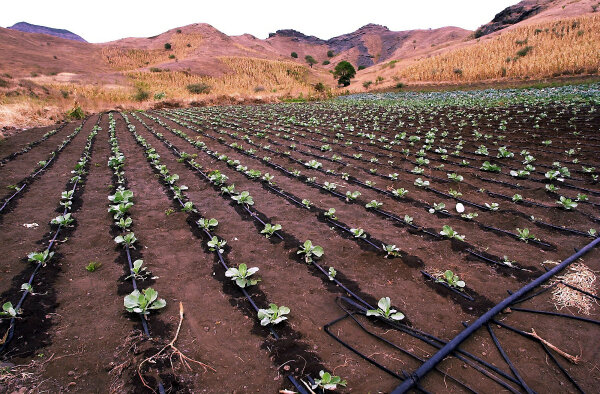
After the soil testing, follows the land preparation, the more land is tilled, the faster its structure and organic content breaks down. Rule is to till only as much as necessary to get the job done. Small clods and crumbly soil improve water penetration and be less likely to crust after heavy rain. For the highest yield, space the rows about 60cm apart, leaving the odd row out for the tractor operating the spray rig. This rows can be in form of shallow ridges or on flat ground. We advice use raised beds 1,6m to 1,8m apart (from center to center) if there is a drainage problem; these reduce the chance of standing water damaging the roots. The beds should be angled to remove excess water from the land after heavy rain. Where the soil is well drained, raised beds will reduce yield. This is because the furrows between beds take up too much room, reducing the plant population.
3.IRRIGATION METHOD
Furrow irrigation is suitable where there is sufficient water. Although this method may seem rather primitive, it requires a great deal of skill. Getting the correct fall and distance between feeder furrows to suit the soil type takes experience. Nevertheless, you can get excellent results with lower input costs, that's through modern Drip Irrigation method. The easiest irrigation method, which is very effective and precise, is the Drip irrigation. we welcome all to our trusted company, for designed drip installation. If you are using pipes and sprinklers, opt for the solid set system, where you simply open valves as you need to. All farmers need to cut down on labor as much as possible. 
For customized drip irrigation, don't hesitate to get in touch with us through; +254746300055 / +254738690937 / sales@dripsol.com.     

Post

Why is diversity so important in the battle with herbicide resistance?

Everyone would like the answers to farming’s problems to be simple, but the fact is, all over-simplistic solutions are prone to coll...